© IceCube Neutrino Observatory
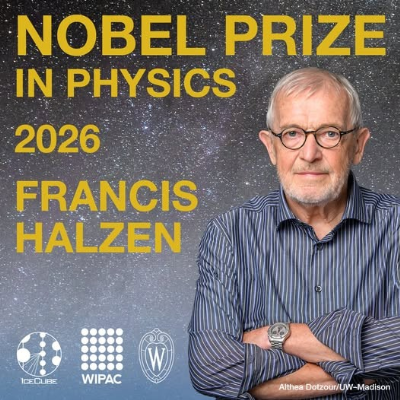
Нобелівську премію з фізики 2026 року присудили американському фізику Френсісу Галзену, професору Університету Вісконсин—Медісон, за його визначальний внесок у створення нейтринної обсерваторії IceCube та відкриття високоенергетичних нейтрино астрофізичного походження. Про це 6 жовтня повідомила Шведська королівська академія наук. Народжений у Бельгії 1944 року, Галзен запропонував використовувати антарктичний лід для дослідження частинок, які долають космічні відстані й несуть інформацію про найенергетичніші процеси у Всесвіті.
Nobel Prize
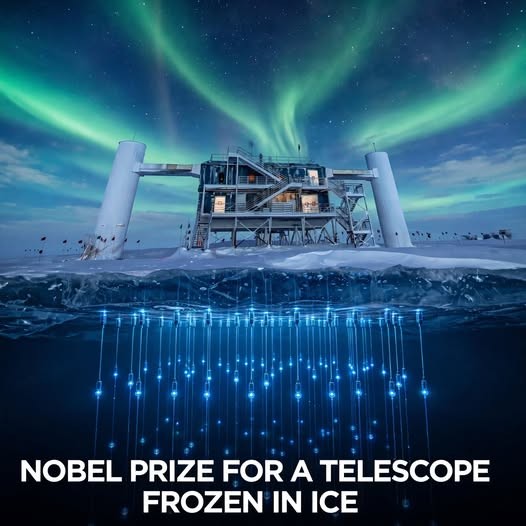
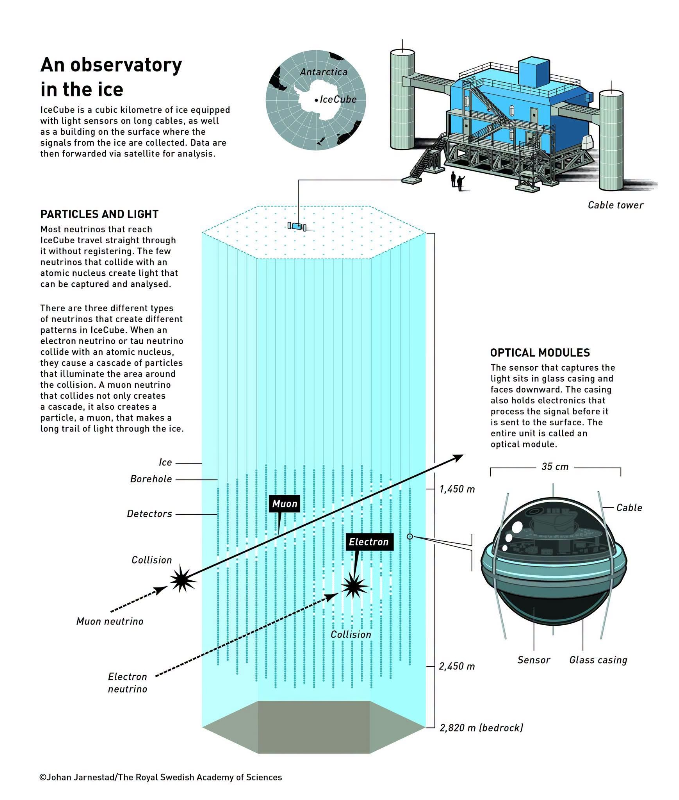
Нейтрино — надзвичайно легкі субатомні частинки, що майже не взаємодіють із речовиною. Вони безперешкодно проходять крізь людське тіло й навіть усю Землю, зберігаючи напрямок руху та енергію. Саме ця властивість робить їх унікальним джерелом інформації про далекі космічні об’єкти. У 1988 році Галзен представив концепцію детектора на Південному полюсі: коли нейтрино взаємодіє з атомним ядром, виникає слабкий спалах світла, який можуть зафіксувати чутливі датчики в прозорому льоду. Так з’явилася ідея IceCube — нейтринного телескопа, вбудованого в антарктичний льодовик поблизу американської станції Амундсена—Скотта. Обсерваторія охоплює близько кубічного кілометра льоду, а її сенсори розташовані на глибині до 2,5 кілометра. Будівництво комплексу завершили 2011 року.
Nobel Prize
IceCube відкрив нові можливості для спостереження за Всесвітом, даючи змогу досліджувати космічні явища, які неможливо повністю зрозуміти за допомогою звичайних телескопів. Ідея Галзена перетворила природний антарктичний лід на гігантський детектор частинок і стала важливим кроком у розвитку нейтринної астрономії. Його нагорода підкреслює значення фундаментальних досліджень, здатних змінити саме уявлення про те, як людство вивчає космос.
Francis Halzen Wins 2026 Nobel Prize in Physics
The 2026 Nobel Prize in Physics has been awarded to American physicist Francis Halzen, a professor at the University of Wisconsin–Madison, for his decisive contributions to the development of the IceCube Neutrino Observatory and the discovery of high-energy astrophysical neutrinos. The Royal Swedish Academy of Sciences announced the award on 6 October. Born in Belgium in 1944, Halzen proposed using Antarctic ice to detect particles travelling across vast cosmic distances and carrying clues to some of the most energetic processes in the Universe.
Neutrinos are extremely light subatomic particles that interact only very weakly with matter. They pass through the human body and even the Earth itself, travelling largely undisturbed and retaining information about their origins. This makes them a unique tool for investigating distant cosmic phenomena. In 1988, Halzen presented his concept for a neutrino detector at the South Pole. When a neutrino interacts with an atomic nucleus, it can produce a faint flash of light that highly sensitive detectors embedded in transparent ice can pick up. This idea led to IceCube, a neutrino telescope built into the Antarctic ice sheet near the US Amundsen–Scott South Pole Station. The observatory instruments roughly one cubic kilometre of ice, with its sensors extending to depths of around 2.5 kilometres. Construction was completed in 2011.
IceCube has opened new avenues for exploring the Universe, enabling scientists to investigate cosmic events that conventional telescopes cannot fully reveal. Halzen’s vision turned naturally occurring Antarctic ice into a vast particle detector, marking a major advance in neutrino astronomy. His Nobel Prize recognises the transformative power of fundamental research — and how an unconventional idea can change the way humanity observes and understands the cosmos.
12