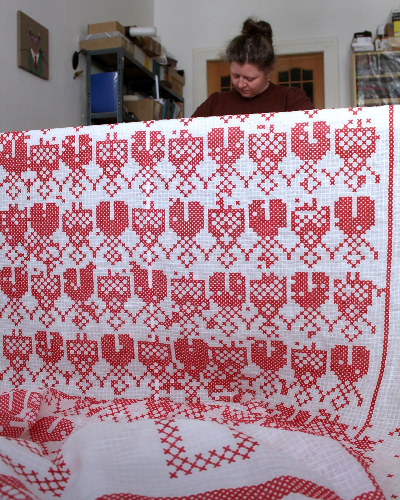
© Facebook Rufina Bazlova
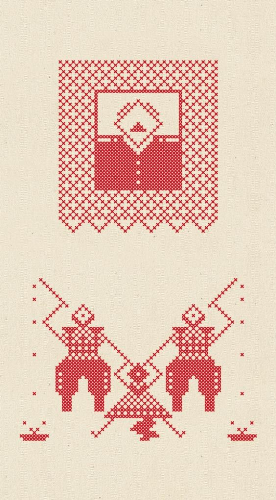
Роботи білоруської мисткині Руфіни Базлової відображають тривожну й болісну реальність сучасної Білорусі. Художниця осмислює масові протести після сфальсифікованих президентських виборів 2020 року та їхнє жорстоке придушення режимом О. Лукашенка: побиття, тортури, масові арешти й ув’язнення політичних опонентів. Також у фокусі її робіт — гуманітарна криза на білорусько-польському кордоні, цинічно використана владою як інструмент політичного тиску. Стилізовані зображення швидко поширилися в інтернеті та стали впізнаваними символами спротиву й демократичної боротьби білоруського суспільства. Сотні протестувальників сприймали ці образи як візуальну мову революції. Візуально роботи виконані у стилі традиційної білоруської вишиванки — червоною ниткою на світлому лляному тлі. Білий колір у вишивці символізує чистоту, світло і свободу, червоний — життя, кров, сонце та добро. У традиційній культурі вишивка слугувала своєрідним кодом, що передавав інформацію про долю народу або окремої людини. Руфіна Базлова продовжує цю традицію, перетворюючи її на сучасну мову розповіді про безправ’я, людські страждання та водночас — про незламність і прагнення до свободи. Свідомо обираючи техніку, історично пов’язану з жіночою працею, мисткиня підкреслює роль жінок у спротиві диктатурі.
Руфіна Базлова — білоруська ілюстраторка, художниця та сценографка, яка тривалий час живе й працює в Чехії. Її серія «вишивок» стала одним із символів білоруського демократичного руху та була представлена на виставках у США, Німеччині, Польщі, Нідерландах, Франції, Швеції, Канаді, Литві та Україні. Творчість мисткині поєднує народну традицію та сучасне політичне висловлювання, мистецтво як форму пам’яті, солідарності та ненасильницького спротиву.
Embroidered Resistance: How Rufina Bazlova’s Art Became the Language of the Belarusian Revolution
The works of Belarusian artist Rufina Bazlova reflect the alarming and painful reality of contemporary Belarus. The artist engages with the mass protests that followed the falsified presidential elections of 2020 and their brutal suppression by the regime of Alexander Lukashenko: beatings, torture, mass arrests, and the imprisonment of political opponents. Her work also addresses the humanitarian crisis on the Belarusian–Polish border, cynically exploited by the authorities as an instrument of political pressure. The stylized images spread rapidly online and became recognizable symbols of resistance and the democratic struggle of Belarusian society. Hundreds of protesters perceived these images as a visual language of revolution. Visually, the works are executed in the style of traditional Belarusian embroidery—red thread on a light linen background. In embroidery, white symbolizes purity, light, and freedom, while red represents life, blood, the sun, and goodness. In traditional culture, embroidery functioned as a kind of code that conveyed information about the fate of a nation or the life of an individual. Rufina Bazlova continues this tradition, transforming it into a contemporary language for telling stories of injustice and human suffering, while also expressing resilience and a desire for freedom. By consciously choosing a technique historically associated with women’s work, the artist emphasizes the role of women in resistance to dictatorship.
Rufina Bazlova is a Belarusian illustrator, artist, and scenographer who has long lived and worked in the Czech Republic. Her series of “embroideries” has become one of the symbols of the Belarusian democratic movement and has been exhibited in the United States, Germany, Poland, the Netherlands, France, Sweden, Canada, Lithuania, and Ukraine. Her artistic practice combines folk tradition with contemporary political expression, treating art as a form of memory, solidarity, and nonviolent resistance.
©
2634